
Generator sizing guide
What Size Generator Do I Need?
Build a practical home backup plan from the loads you want to run, the motors that must start, and the generator ratings that apply to your fuel.
Last reviewed:
How to size a home generator
The right size is not a single wattage pulled from your home’s square footage or electrical-service rating. It comes from the loads you plan to power, how much they draw while running, and what happens when the largest motor or compressor starts. Use this six-step process to prepare a useful planning estimate.
1. Decide what you want to keep running
Build an outage load list—not an inventory of everything you own. Include only the equipment you reasonably expect to power, and group it by what matters most to your household:
- Must-have loads: refrigerator or freezer, well or sump pump, essential lighting and outlets, internet equipment, and medical or accessibility equipment.
- Comfort and convenience: heating or cooling, cooking, water heating, and other loads you would like to use when capacity allows.
- Deferred or managed loads: an EV charger, electric dryer or range, secondary HVAC, and other equipment that does not need to run at the same time.
Your priorities may differ, especially where heating, cooling, or water supply is essential. The important decision is what may need to operate together and what can wait.
2. Gather the ratings for those loads
Now collect the best available data for the equipment on your list. Check its nameplate or data plate first, then the manufacturer’s documentation. Record watts when they are provided as a usable rated input. When a load is entered in amps, record its voltage too—120 V and 230/240 V equipment with the same amperage do not represent the same load. For motors and compressors, use nameplate or manufacturer starting-current data, or a qualified technician’s measured starting current, when available.
A second example: a 120 V refrigerator nameplate
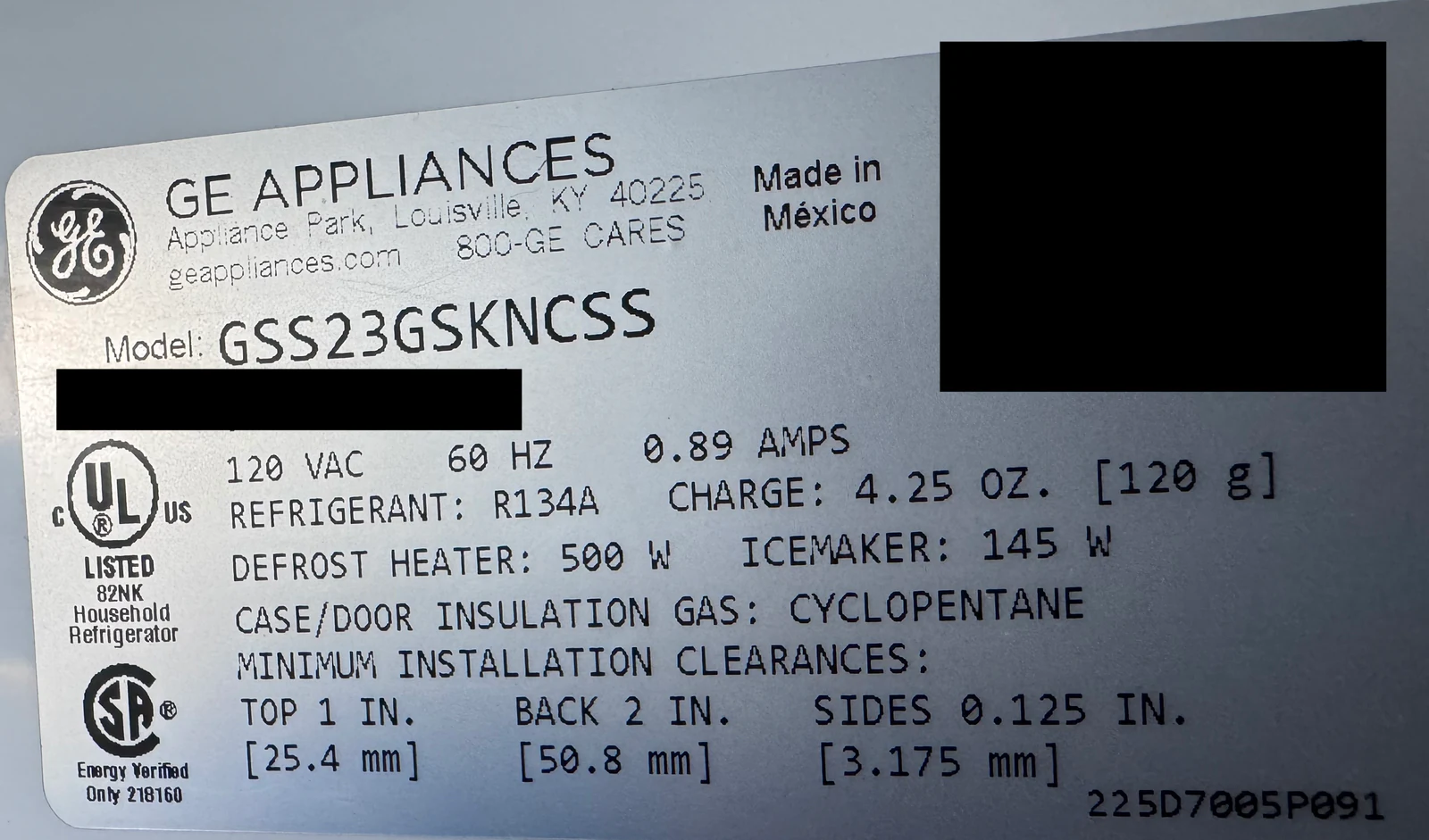
This plate lists 120 V and 0.89 A, so that amp rating corresponds to 120 V × 0.89 A = 106.8 VA. It also lists a 500 W defrost heater and a 145 W icemaker. Those are different operating modes or components, not values to combine into one universal maximum without manufacturer guidance.
The lesson is the same: pair an amp value with the voltage of the equipment it came from. Do not convert a 120 V load as though it were a 240 V load.
For help with a common high-starting load, see our guide to well pump starting watts.
3. Enter your loads in the calculator
Enter the outage loads you selected, using the voltage, watts, amps, and starting information you found. For an outdoor unit, enter its nameplate voltage and MCA; if MCA is absent, use RLA or manufacturer running current. Enter LRA or measured starting current separately. Add your home details, intended fuel, and any loads you plan to manage. The calculator will estimate continuous running demand and the separate peak requirement for the largest motor or compressor start.
4. Review continuous running demand
This is the demand from the loads expected to operate together after applicable demand treatment. The calculator applies your selected continuous headroom separately, so the generator is not planned to run at its full continuous rating under the modeled load.
5. Check the largest motor or compressor start
Motors and compressors can draw much more while starting than while running. The calculator builds a peak-start scenario for the selected source by replacing that source’s running contribution with its starting contribution. It does not add both values for the same equipment.
6. Compare both results with real generator specifications
A candidate generator must satisfy both the fuel-specific continuous requirement and the peak-start requirement. Confirm the actual product’s natural-gas, propane, or gasoline rating; motor-start or voltage-dip data; and installation limits. A kW label alone is not enough.
Final selection also depends on fuel supply, electrical configuration, transfer equipment, clearances, local requirements, and professional review.
What the calculator is checking
Running demand and starting demand
The calculator keeps two questions separate:
- Can the generator carry the demand-adjusted running VA of the planned loads?
- Can it carry the peak VA while the selected motor or compressor starts?
When equipment is entered in amps, apparent power depends on its source voltage: 120 V × amps for 120 V equipment, and the entered 230/240 V × amps for line-to-line equipment. That voltage remains part of the starting-load calculation too. After the full peak scenario is expressed in VA, the whole-home optional-standby amp result is total peak VA ÷ 240 V.
Fuel, location, and headroom
The calculator compares a standby candidate with its rating for the selected fuel rather than assuming one universal natural-gas or propane adjustment. Its resolved elevation and temperature adjustment applies to both continuous and peak requirements. Your chosen headroom applies only to continuous demand.
Connection and installation
Residential backup systems are commonly planned as optional standby systems under NEC Article 702. Installation must safely isolate generator power from the utility and prevent backfeeding. A licensed electrician and the local authority having jurisdiction should confirm the permitted transfer equipment, grounding, conductors, overcurrent protection, and installation details. See our comparison of a transfer switch and interlock and our calculator disclaimer.
Worked example: sizing a generator for a 1,500 sq ft home
This example shows how the running and starting checks fit together. It uses the calculator’s current defaults and screening logic; your home’s nameplates and planned loads should replace them wherever possible.
Example inputs
- A 1,500 sq ft home
- Two small-appliance circuits and one laundry circuit
- A 150 W refrigerator and the calculator’s 900 W sump-pump default
- One central A/C outdoor unit entered at 240 V and a 20 A running-current input
- No heating, EV charging, soft start, or load management
- Sea-level and 60°F defaults, with 20% continuous headroom
Here, 20 A represents the nameplate MCA, or the RLA/manufacturer running current when MCA is not listed. The sump default is 7.5 A at 120 V, or 900 VA running. The A/C contributes 240 V × 20 A = 4,800 VA while running.
Running-demand calculation
- General lighting1,500 sq ft × 3 VA = 4,500 VA
- Small-appliance circuits2 × 1,500 VA = 3,000 VA
- Laundry circuit1 × 1,500 VA = 1,500 VA
- Refrigerator + sump pump150 + 900 = 1,050 VA
The raw general-load total is 10,050 VA. Under the calculator’s current optional-dwelling implementation, the first 10,000 VA is counted at 100% and the remaining 50 VA at 40%: 10,000 + (50 × 0.40) = 10,020 VA. Central A/C is the only HVAC candidate, so its 4,800 VA planning load is included at 100%.
Running demand: 10,020 + 4,800 = 14,820 VA
Peak-start calculation
The sump screening estimate is 22.5 A at 120 V, or 2,700 starting VA. For the 20 A A/C entry, the calculator’s visible Generac-based screening estimate is 117 starting amps: 117 A × 240 V = 28,080 VA. That 117 A value is a screening input, not an NEC demand factor; actual nameplate or manufacturer starting data takes precedence. Because 28,080 VA is larger, the A/C is the selected starting-load source.
- Start with running demand14,820 VA
- Remove the A/C running contribution14,820 − 4,800 = 10,020 VA
- Add the A/C starting contribution10,020 + 28,080 = 38,100 VA peak
Continuous and surge checks
The 20% headroom setting applies to continuous running demand, not to the peak-start scenario. Continuous demand with headroom is 14,820 ÷ 0.8 = 18,525 VA, or 77.1875 A at 240 V; the calculator displays 78 A. Peak demand is 38,100 ÷ 240 = 158.75 A; the calculator displays 159 A. In plain English, the setting targets the modeled running load at no more than 80% of continuous planning capacity. That is why the calculation divides by 0.80 rather than multiplying by 1.20.
With the example’s default location assumptions, the current versioned standby catalog does not suggest a class. The 18,525 VA continuous requirement and 38,100 VA peak check are below the smallest active, source-validated air-cooled row; the former 22 kW row is suppressed because its stored numeric start value was not confirmed in the cited primary source. This is a fail-safe catalog-boundary planning result, not approval of a particular generator. Review the methodology and generator source register. Final equipment selection must use the actual product’s fuel rating, voltage-dip and motor-start data, installation conditions, and electrician review.
Method and source boundaries: The general-load and HVAC demand treatments above document SizeMyGenerator’s current project implementation of its 2023 NEC optional-dwelling methodology; local NEC adoption and AHJ requirements can differ. Voltage, MCA, RLA, and LRA are distinct equipment/nameplate inputs: the calculator prefers MCA for its outdoor running-current field, uses RLA or manufacturer running current only when MCA is absent, and keeps LRA separate. The 117 A fallback is a SizeMyGenerator screening estimate derived from Table 1 of Generac’s Generator Sizing Guide, Part A0000641269, Rev. B (2020). The 20% headroom is a user-selectable planning setting, not a motor-start multiplier or an NEC demand factor.
Why square footage alone cannot choose a generator
Square footage establishes only the calculator’s general-lighting input. Homes of the same size can have very different HVAC, pump, cooking, water-heating, EV, and managed-load requirements. Choose a standby planning class only after comparing the calculated continuous requirement and the separate peak-start requirement with fuel-specific catalog data.
For service-specific planning, see our guides to generator sizing for 100-amp service, generator sizing for 150-amp service and generator sizing for 200-amp service.
Generator types to consider
Portable generators
A manually fueled option for selected loads. They must operate outdoors, well away from openings, and connect through appliance cords or approved transfer equipment—not by backfeeding a receptacle. The calculator on this site returns standby planning classes and must not be used as a portable selection. Compare the exact portable model’s fuel-specific continuous and starting output, 120/240 V capability, receptacle and breaker limits, per-leg loading, connection path, runtime, and fuel storage.
Inverter generators
A portable-generator category valued for quieter operation, efficient part-load performance, and model-specific waveform characteristics. “Inverter” does not establish load compatibility; product-specific running and starting output, fuel, receptacles, per-leg limits, and 120/240 V capability still determine what the unit can serve.
Air-cooled standby generators
Permanently installed systems that can start automatically and serve selected or broad household loads. Compare natural-gas and propane ratings separately, verify motor-start performance, and plan load management when large loads should not run together.
Liquid-cooled standby generators
Permanently installed systems for larger or more demanding applications, including homes with substantial simultaneous loads or longer-duty expectations. They bring different space, fuel-supply, cost, and service considerations and warrant detailed dealer and engineering review.
Solar-plus-battery systems
Battery backup is constrained by both inverter output in kW and stored energy in kWh, while solar recharge depends on weather and system design. Size it from an essential-load profile and outage-duration goal rather than treating it as a direct substitute for a fuel generator’s rating.
Common generator-sizing mistakes
- Sizing from square footage, service amps, or a single kW rule of thumb
- Ignoring starting current or using 120 V for a 230/240 V source
- Counting every appliance without deciding what will actually run together
- Comparing the requirement with the wrong fuel rating
- Applying continuous headroom again to the peak-start scenario
- Choosing transfer equipment before defining the backed-up loads
- Leaving no plan for future HVAC, pump, EV, or appliance changes
When to call a professional
Use the calculator to prepare for a productive conversation, not to issue an installation design. A licensed electrician should evaluate your panel, conductors, transfer equipment, grounding and bonding, motor-start behavior, fuel-dependent generator rating, and local code requirements. Fuel piping, storage, clearances, and permits may require additional qualified professionals.
For broader generator safety guidance, see the U.S. Consumer Product Safety Commission. Installation requirements may also be influenced by standards from the National Fire Protection Association (NFPA).
Calculate your generator size
Gather the equipment details you have now, enter the loads that matter, and replace planning defaults as you find better nameplate or manufacturer data. Keep the continuous and peak-start checks separate all the way to final product selection.
Still have questions? Visit our Generator FAQs.
Planning to buy a generator?
Tell us what you are considering and when you expect to buy. We will review your information and reply with the most useful next step. You can also request local installer introductions as that service becomes available.